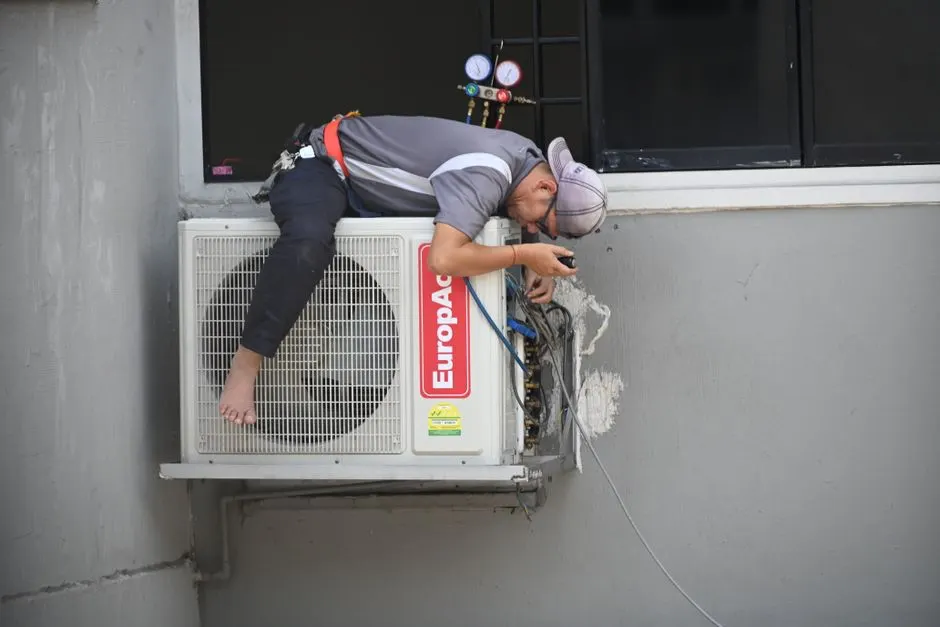
Your AC is leaking water inside the house because the condensate drain line is clogged, the drain pan is cracked, or the unit is freezing up and melting onto your floor. In Orlando, the clogged drain line is the culprit about 70% of the time - our humidity runs 70-90% from May through October, and that constant condensation carries dust, algae, and biofilm straight into the drain. The rest of this post walks through every cause we see on service calls, what you can safely check yourself, and what a repair costs in 2026.
Why is my AC leaking water inside my Orlando home?
An AC leaking water in Orlando is almost always a drainage problem, not a cooling problem. Your air handler pulls moisture out of the air as it cools - a typical 3-ton system in Central Florida removes 15 to 25 gallons of water per day during peak summer. That water has to go somewhere. When it can't drain, it ends up on your floor, in your ceiling, or inside your walls.
The reason Orlando sees this more than drier markets is simple math. Our average relative humidity sits between 70% and 90% for most of the year, and the rainy season dumps 7 to 8 inches of rain per month from June through September. Your system is pulling water out of the air nonstop, and every ounce of it flows through one 3/4-inch PVC pipe. That pipe clogs.
If you're seeing water and your system is also blowing warm air, the problem may be bigger than a drain. In that case, AC repair Orlando FL is the right call - we diagnose both issues on the same visit.
The six causes we find on Orlando service calls
After thousands of leak calls across Orange, Seminole, and Osceola counties, the same six causes show up again and again. Here's what each one looks like and how we fix it.
1. Clogged condensate drain line
This is the big one. Algae, dust, and biological growth build up inside the drain line over 12 to 24 months, and eventually the water backs up. You'll usually see water pooling around the indoor air handler, or a wet spot on the ceiling directly below it. The fix is a drain line clearing - we use a combination of vacuum pressure and a flush to break up the blockage, then treat the line to slow regrowth.
2. Clogged or dirty air filter
A filter that hasn't been changed in 60 to 90 days restricts airflow across the evaporator coil. The coil gets too cold, condensation freezes on it, and when the system cycles off, that ice melts faster than the drain can handle. We see this constantly in Orlando homes where the filter sits in a hallway return grille that's easy to forget. Change it every 30 days during summer.
3. Frozen evaporator coil
Low refrigerant, a failing blower motor, or restricted airflow can all drop the coil below 32°F. Ice builds up, then melts into the drain pan - often more water than the pan can hold. If you see ice on the copper lines or the indoor unit, turn the system off at the thermostat and let it thaw for 2 to 3 hours before running it again. If it freezes a second time, you have a refrigerant or airflow issue that needs a technician.
4. Cracked or rusted drain pan
The drain pan under your air handler is usually plastic or galvanized steel. In Florida's humidity, steel pans rust through in 8 to 12 years. Once a pan cracks, water drips straight through to the ceiling or floor no matter how clean the drain line is. We replace pans with UV-resistant plastic models that hold up better in our climate.
5. Disconnected or improperly sloped drain line
Drain lines need a consistent downward slope of at least 1/8 inch per foot. If a line sags, was bumped during a repair, or was installed flat, water sits in the low spot and eventually backs up. We see this a lot in older homes around College Park HVAC systems, where additions and renovations have moved or rerouted drain lines without re-checking the slope.
6. Refrigerant leak causing coil ice
An AC leaking refrigerant Orlando homeowners often mistake for a water problem. Low refrigerant drops coil pressure and temperature, the coil freezes, and the meltwater overflows the pan. If your system is also struggling to cool, running long cycles, or you hear a hissing sound near the indoor unit, refrigerant is the likely cause. This one requires a licensed technician - refrigerant handling is regulated under Section 608 of the Clean Air Act.
How do I stop my AC from leaking water in Orlando FL?
You can stop most AC water leaks in Orlando by clearing the drain line, changing the filter, and confirming the system isn't frozen. Here's the order we recommend, safest first:
- Turn the system off at the thermostat. This stops new condensation from forming while you work.
- Check the air filter. If it's gray, matted, or more than 30 days old in summer, replace it. A $15 filter prevents a $200 service call.
- Look for ice on the indoor unit. If you see ice, let it thaw for 2 to 3 hours with the fan running in "on" mode. Do not chip at it.
- Find the drain line and the cleanout cap. It's the white PVC pipe near the air handler, usually with a T-shaped cap you can unscrew.
- Wet-vac the line. Put a wet/dry vac on the open cleanout and run it for 1 to 2 minutes. You'll often pull out a slug of algae and slime.
- Flush with water. Pour a gallon of water down the cleanout and watch for it to drain freely at the outdoor termination point.
If the line clears and stays clear, you've solved it. If it clogs again within a few weeks, the growth is deeper in the line and needs professional clearing. That's when you call for AC water leak repair Orlando homeowners can count on - we clear the line, treat it, and check the pan and float switch while we're there.
Is AC water leak dangerous in Orlando?
An AC water leak in Orlando is rarely an immediate health hazard, but it becomes a serious property problem fast. The water itself is condensation - clean at the source. The danger is where it goes and what it touches.
Three real risks:
- Mold growth in 24 to 48 hours. Orlando's indoor humidity sits at 55-65% even with the AC running. Wet drywall, insulation, or ceiling tile in that environment grows visible mold in two days. Remediation runs $1,500 to $6,000 depending on square footage.
- Structural damage. Water pooling under an air handler rots subfloor and framing. Ceiling drywall that stays wet sags and eventually collapses.
- Electrical hazard. If the leak reaches the air handler's electrical compartment or a nearby outlet, you're looking at a shock risk and possible fire. Turn the breaker off if water is anywhere near the unit.
If the leak has been running for more than a day, treat it as a water-damage issue first and an HVAC issue second. We can stop the source, but drying and mold assessment may need a separate remediation team.
How much does AC leak repair cost in Orlando?
Typical 2026 pricing for AC leak repair in Orlando runs $150 to $450 for a drain line clearing, $250 to $600 for a drain pan replacement, and $400 to $1,200 if refrigerant is involved. Here's the breakdown we give customers before we start:
- Drain line clearing and treatment: $150-$275
- Float switch replacement (safety shutoff): $125-$250
- Drain pan replacement: $250-$600, depending on pan size and access
- Evaporator coil cleaning: $200-$450
- Refrigerant leak detection and repair: $400-$1,200, plus refrigerant recharge
- Emergency or after-hours service: add $100-$200
If your system is 12 to 15 years old and the leak is paired with a failing coil or compressor, repair may not be the smart money. A new unit runs $5,500 to $9,500 installed in Orlando, and we'll tell you honestly when replacement beats repair. You can see current options on our AC installation Orlando FL page.
Common mistakes we see homeowners make
The mistakes that turn a $200 drain clearing into a $4,000 water-damage claim are predictable. Watch for these:
- Ignoring the first drip. A slow drip under the air handler means the pan is already overflowing. Waiting a week lets water soak into drywall and subfloor.
- Running the system while it's frozen. This burns out the compressor - a $1,800 to $2,800 part. Let it thaw completely.
- Poking a wire or coat hanger down the drain line. You'll punch through the PVC or push the clog deeper. Use a wet-vac, not a wire.
- Bypassing the float switch. That little switch shuts the system off when the pan fills. Taping it up or removing it means the next overflow floods your ceiling.
- Skipping the filter. A $15 filter every 30 days in summer is the cheapest insurance you'll ever buy for your system.
- Assuming it's just condensation. If the leak is near the refrigerant lines and the system isn't cooling well, it's not water - it's refrigerant oil, and that's a different repair.
We also see this pattern in newer builds around Lake Nona HVAC systems, where tight construction and high-efficiency equipment mean smaller drain lines that clog faster than the older 1-inch lines in established neighborhoods.
When to call a professional
Call a professional when the drain line clogs again within 30 days, when you see ice on the indoor unit, when the leak is anywhere near electrical components, or when you smell a musty odor that suggests mold. Those four situations are beyond what a homeowner should handle.
At Orlando HVAC Air Conditioning, we handle AC water leak repair across Orlando and the surrounding suburbs. We find the leak, clear or replace what's causing it, test the drain under full flow, and check the float switch before we leave. If you're not sure whether your issue is a drain clog or something bigger, we'll diagnose it and give you a straight answer on what it takes to fix it.
If you want to prevent the next leak before it happens, our AC maintenance Orlando FL visits include a drain line flush, pan inspection, and float switch test - the three things that stop most leaks cold.
Frequently Asked Questions
Why is my AC leaking water inside my Orlando home?
The most common cause is a clogged condensate drain line - Orlando's 70-90% humidity pushes 15-25 gallons of water per day through a 3/4-inch pipe, and algae clogs it within 12 to 24 months. Other causes include a dirty filter, frozen coil, cracked drain pan, or low refrigerant.
How do I stop my AC from leaking water in Orlando FL?
Turn the system off, change the filter if it's more than 30 days old, let the coil thaw for 2-3 hours if it's frozen, then wet-vac the drain line cleanout for 1-2 minutes. If the leak returns within a few weeks, call a technician - the clog is deeper than a homeowner can reach.
Is AC water leak dangerous in Orlando?
Not immediately, but mold can grow in 24-48 hours in Orlando's indoor humidity, and water near the air handler's electrical compartment is a shock and fire risk. If the leak has run more than a day, treat it as water damage and call for drying and mold assessment.
How much does AC leak repair cost in Orlando?
In 2026, expect $150-$275 for a drain line clearing, $250-$600 for a drain pan replacement, and $400-$1,200 if refrigerant is involved. Emergency or after-hours service adds $100-$200. Most standard drain clogs fall in the $150-$300 range.
Can I fix AC water leak myself in Orlando Florida?
You can clear a simple drain line clog with a wet-vac and change your filter - that solves about half the leaks we get called for. If the system is frozen, the pan is cracked, or refrigerant is low, it needs a licensed technician. Refrigerant work is regulated under Section 608 of the Clean Air Act.
Get help with HVAC in Orlando
If your AC is leaking and you want it fixed today, call Orlando HVAC Air Conditioning at 689 315 0679. We'll find the source, stop the leak, and test the drain before we leave - no guesswork, no repeat visits.
We serve homeowners across Orlando and the surrounding areas, and we offer same-day service on most leak calls. One call, and your floor stays dry.