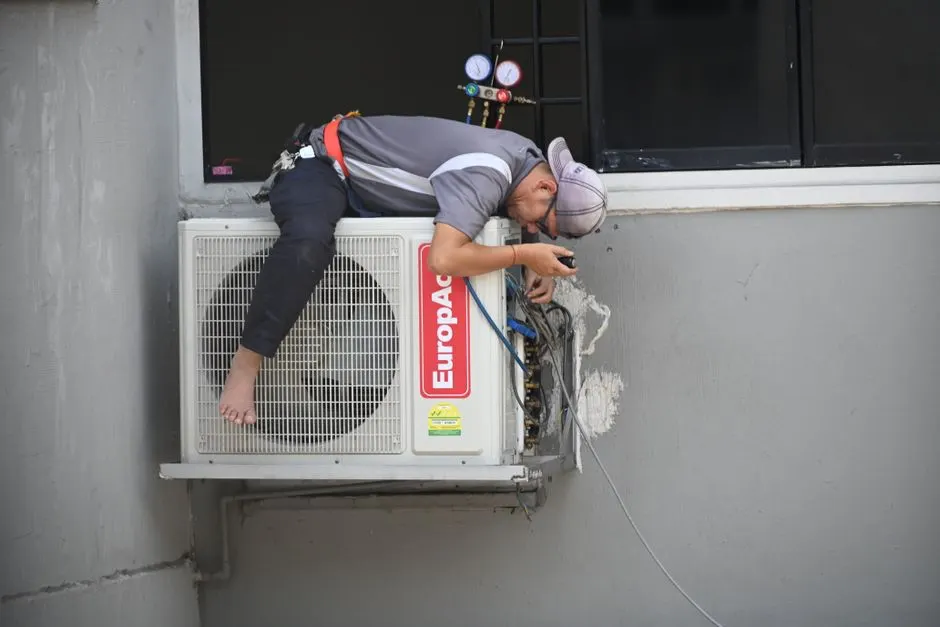
Your AC is running, the fan is blowing, but the air coming out of the vents feels warm or room-temperature. In Orlando, that almost always means one of five things: a clogged air filter, a thermostat set wrong, a frozen evaporator coil, low refrigerant from a leak, or a failing compressor. The first two you can fix yourself in minutes. The last three need a licensed technician.
We handle AC blowing warm air calls across Orlando every week, from College Park bungalows to Lake Nona new builds. Below we walk through the quick checks, the real causes, what each repair costs in 2026, and when it is time to stop troubleshooting and call us.
The short answer: why your Orlando AC is blowing warm air
AC blowing warm air in Orlando is a cooling failure that happens when the system runs but cannot move heat out of your home. The indoor fan still pushes air, but the refrigerant loop is not doing its job, so you feel warm air instead of cold.
Three things cause 80% of these calls: restricted airflow (dirty filter, blocked return, closed vents), a refrigerant problem (low charge from a leak, or a frozen coil), and an electrical or mechanical failure (bad capacitor, stuck contactor, failing compressor).
If the air is warm but the outdoor unit is humming normally, start with airflow. If the outdoor unit is silent or clicking, it is electrical. If you see ice on the copper lines or the indoor coil, it is refrigerant or airflow.
Quick checks you can do in five minutes
Before you call anyone, run these five checks. They solve a surprising number of warm-air complaints without a service visit.
- Check the thermostat. Make sure it is set to COOL, not FAN or HEAT, and that the setpoint is at least 3 degrees below the current room temperature. In November in Orlando, it is easy to bump the mode by accident.
- Replace the air filter. A clogged filter chokes airflow and can freeze the coil within hours. If you cannot see light through it, replace it. We recommend a MERV 8 to MERV 11 filter changed every 30 to 60 days in Central Florida because of dust and pollen.
- Check the outdoor unit. Confirm the breaker at the panel and the disconnect box near the condenser are both ON. Look for ice on the large copper line. If it is iced, turn the system off at the thermostat and let it thaw for 2 to 4 hours before restarting.
- Open your vents. Walk the house and make sure no supply registers or return grilles are closed or blocked by furniture, rugs, or boxes.
- Look at the condensate drain. A clogged drain line can trip the float switch and shut down cooling while the fan keeps running. If you see standing water in the pan, that is your sign.
If all five check out and the air is still warm, the problem is inside the system. That is when you call us for AC repair Orlando FL.
What causes AC to blow warm air in Orlando?
What causes AC to blow warm air in Orlando comes down to a short list of mechanical and refrigerant failures. Here is what we find on service calls, roughly in order of frequency.
Low refrigerant from a leak
Low refrigerant is the number one cause of warm air we see. Refrigerant does not get used up like gas in a car. If the charge is low, there is a leak somewhere in the line set, coil, or fittings. Adding refrigerant without finding the leak is a temporary patch that fails again within a season.
Signs of low charge: warm air at the vents, ice on the indoor coil or the large copper line, a hissing or bubbling sound near the outdoor unit, and electric bills that climb month over month. A proper leak search and recharge runs $350 to $900 in 2026 depending on refrigerant type and leak location.
Frozen evaporator coil
A frozen coil blocks airflow completely. The system runs, but no cold air reaches your rooms. Freezing happens when airflow is restricted (dirty filter, closed vents, undersized ductwork) or when refrigerant is low. Turn the system to OFF at the thermostat, not just the fan, and let it thaw. If it freezes again within a day, you have a refrigerant or airflow problem that needs a technician.
Bad capacitor or contactor
The capacitor gives the compressor and condenser fan motor the jolt they need to start. When it fails, the outdoor unit hums, clicks, or stays silent while the indoor fan keeps blowing. A replacement capacitor is one of the cheapest fixes we do, usually $150 to $300 installed in Orlando. A stuck contactor has similar symptoms and similar cost.
Failing compressor
The compressor is the heart of the system. When it fails, you get warm air, a tripped breaker, or a loud clunk on startup. Compressor replacement runs $1,200 to $2,200 installed, and on systems older than 12 years it often makes more sense to put that money toward AC installation Orlando FL instead.
Duct problems
Torn, disconnected, or crushed ducts dump cold air into your attic instead of your rooms. In Orlando attics that hit 140 degrees in summer, that lost air is a real problem. If some rooms are cold and others are warm, ducts are a likely culprit. We inspect and seal ductwork as part of duct cleaning Orlando FL service calls.
Thermostat or control board failure
A thermostat that reads the wrong temperature, or a control board that stops signaling the outdoor unit, will run the fan without cooling. If your thermostat display is blank, flickering, or stuck on a temperature that does not match the room, that is your starting point. Smart thermostat replacements start around $250 installed.
Why Orlando heat makes warm-air problems worse
Orlando summers push AC systems harder than almost anywhere in the country. When the outdoor temperature sits at 95 degrees with 70% humidity for weeks, your system runs 12 to 16 hours a day. That constant runtime accelerates wear on capacitors, contactors, and compressors, and it exposes small refrigerant leaks that would stay hidden in a milder climate.
We see the same pattern every June through September: systems that were marginal in April fail completely by July. The homeowners who avoid emergency calls are the ones who schedule AC maintenance Orlando FL in March or April, before the first 95-degree week.
Neighborhood matters too. Older homes in College Park HVAC territory often have original ductwork sized for 1980s systems, which chokes modern high-efficiency units and causes freezing. Newer construction in Lake Nona HVAC service areas tends to have tighter envelopes and different airflow needs. We adjust our diagnosis to the house, not just the equipment.
Common mistakes to avoid
Most warm-air problems get worse because of what homeowners do in the first hour. Skip these.
- Adding refrigerant without a leak search. Topping off a leaking system wastes money and damages the compressor over time.
- Running the system with a frozen coil. This can flood the compressor with liquid refrigerant and turn a $400 repair into a $2,000 replacement.
- Setting the thermostat 10 degrees lower to "force" cold air. It does not cool faster and it strains the system.
- Replacing the thermostat first. A new thermostat rarely fixes warm air. Diagnose the system, not the display.
- Ignoring a tripped breaker. If the outdoor breaker trips twice, stop resetting it. There is a fault that needs a technician.
When to call a professional
Call a licensed HVAC technician when the air is still warm after you have replaced the filter, checked the thermostat, and confirmed the outdoor unit is running. Also call if you see ice on the lines, smell burning near the air handler, hear grinding or clanking from the condenser, or notice the breaker tripping repeatedly.
Our team at Orlando HVAC Air Conditioning diagnoses warm-air calls same day across Orlando and the surrounding areas. We test refrigerant charge, amp draw on the compressor, capacitor condition, and airflow static pressure before we recommend anything. You get a straight answer on what is wrong and what it costs to fix.
If your system is more than 12 years old and the repair is over $1,500, ask us to price a replacement side by side. Sometimes the honest answer is that a new system is the better spend.
Frequently Asked Questions
Why is my AC blowing warm air in Orlando?
The most common causes are a dirty air filter, low refrigerant from a leak, a frozen evaporator coil, a failed capacitor, or a failing compressor. Start with the filter and thermostat. If those are fine and the outdoor unit is running, you likely have a refrigerant or electrical issue.
How do I fix AC blowing warm air in Orlando FL?
Replace the air filter, confirm the thermostat is set to COOL, check that the outdoor breaker and disconnect are on, and open any closed vents. If the air is still warm after 30 minutes, call a technician. Refrigerant and compressor repairs require a licensed pro and EPA-certified handling.
Should I call an HVAC pro if my AC blows warm air in Orlando?
Yes, if the filter and thermostat are fine and the air is still warm. Most warm-air causes beyond airflow involve refrigerant, capacitors, or the compressor, and those need diagnostic tools and licensing. Same-day service is standard in Orlando during cooling season.
What causes AC to blow warm air in Orlando Florida?
Orlando-specific causes include refrigerant leaks accelerated by year-round runtime, frozen coils from undersized 1980s ductwork in older neighborhoods, and capacitor failures from the long cooling season. Humidity and 95-degree summers push systems harder than most U.S. markets.
Can low refrigerant cause warm air in Orlando AC?
Yes. Low refrigerant is the single most common cause of warm air we find. A system that is 10 to 15% low on charge can lose most of its cooling capacity. The fix is a leak search, repair, and recharge, typically $350 to $900 in 2026.
Get help with HVAC in Orlando
If your AC is blowing warm air and the quick checks did not solve it, we can be at your door today. Our technicians carry capacitors, contactors, and refrigerant on every truck, so most warm-air calls are fixed in one visit.
Call Orlando HVAC Air Conditioning at 689 315 0679 and we will get your cold air back.